Ask
Sell a whole bag for one price in ETH. The buyer pays in a single transaction and receives the full amount.
Post an ask →Prices and depth are read from on-chain pools every few minutes, and every listed token is quoted through the best aggregator route. The last figure counts where even that route costs a $100,000 seller 2 % or more.
Live from the desk
What is Quayside?
A holder signs a price for the whole position. A buyer accepts it from their own wallet, and the settlement contract moves the coins one way and the ETH the other in the same transaction.
Because no pool sits in between, the trade leaves no candle behind: no slippage for the seller, no spike for the buyer, nothing for a bot to front-run.
For sellers and buyers
Post an ask to sell or a bid to buy, publicly or for one named wallet. Your tokens never leave your wallet until the moment the trade settles.
From a signed price to a settled fill — no deposit, and no key on our side
Sell a bag Example
Settlement contract Checks on chain
Choose the token, the size and one price in ETH. Signing costs nothing and moves nothing; your bag stays where it is.
The contract verifies your signature, the price, the size and, if you set one, the Chainlink band. No server signs anything.
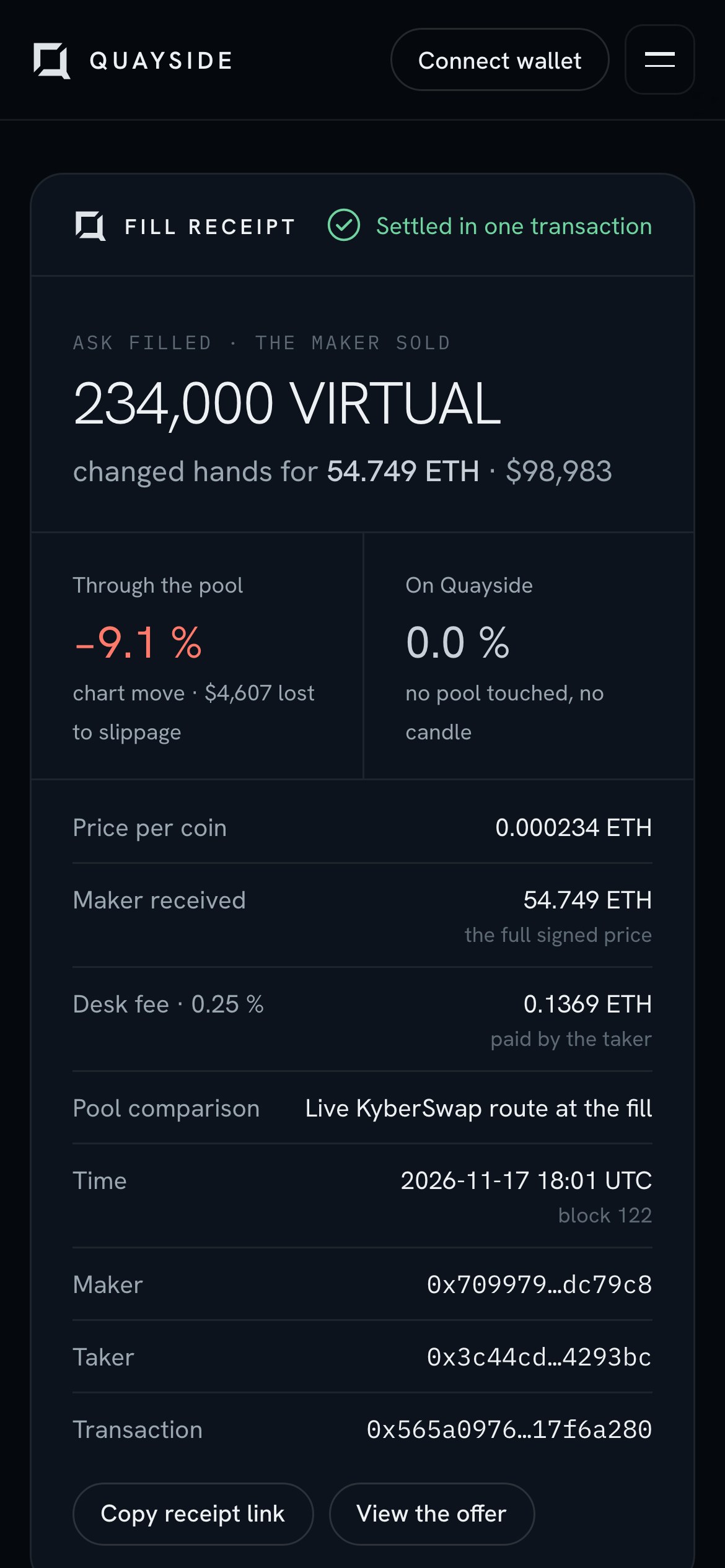
Both legs move together or nothing moves at all. Every fill gets a public receipt with what the pool would have cost.
Product demo
Under forty seconds, start to finish: a seller prices 234,000 VIRTUAL once, a buyer takes it, and the receipt lands — recorded straight from the desk app.
Recorded on a test network with test wallets. Prices and pool quotes are live from Robinhood Chain.
An offer is a price its owner signed. A fill is one transaction anyone can read, and its receipt shows what selling into the pool would have cost.
Live quotes for selling a whole bag through the best on-chain route, next to the same bag on Quayside.
| Loading the market… |
Best-route quotes via KyberSwap across every Robinhood Chain pool.
Whatever the size or the counterparty, there is an offer shape for it
Sell a whole bag for one price in ETH. The buyer pays in a single transaction and receives the full amount.
Post an ask →Name what you would pay for a bag you want. Funds stay in your wallet as WETH until a seller fills you.
Post a bid →Address an offer to one wallet. Nobody else can take it, and it never appears on the public book.
How private offers work →Let several buyers take pieces at your price. Whatever is not taken stays open until it expires.
How partial fills work →For stock tokens, set a band around the Chainlink price. If the market moves past it, your offer simply cannot fill.
How the guard works →Withdraw one offer, or every offer you have signed, with a single on-chain call. It takes effect immediately.
How cancelling works →Quayside runs a public order board. Everything that touches funds happens in the settlement contract, and the contract answers only to your signature.
Settlement contract · published at launchFees fund $QUAY buybacks
Connect a wallet on Robinhood Chain, pick a token and name your price. No deposit, no pool, no slippage.
A flat 0.25 % of each fill, paid by the taker and fixed in the contract. Makers always receive the full price they signed. Robinhood Chain's own network fee applies to any transaction you send.
No. Posting is a signature, not a deposit. You approve the settlement contract for the amount, and it can only use that approval inside a fill that matches your signed terms.
Nothing is lost. Offers live as signatures and funds live in your wallet. Anyone can fill or cancel directly through the verified contract on the explorer.
An optional band you set on stock-token offers. At the moment of the fill, the contract compares your price with the Chainlink feed and refuses the trade if the market has moved beyond your band.
Yes. Allow partial fills and several buyers can each take a piece at your price. The remainder stays open until it is filled, cancelled or expires.
Any browser wallet that supports Robinhood Chain. The desk detects installed wallets and asks to switch networks when needed.
Desk fees go to the treasury and are used to buy back $QUAY. Every buyback is posted with its transaction.
New listings, the largest offers as they post, and what the pools would have charged for them.